Materials
Why Choose TC4 Titanium Bicycle Bolts? What Matters Beyond Weight?
What do TC4, Ti-6Al-4V and Grade 5 mean? A practical guide to material properties, rotor bolt dimensions and installation requirements when choosing titanium bicycle hardware.
Published: · Updated:
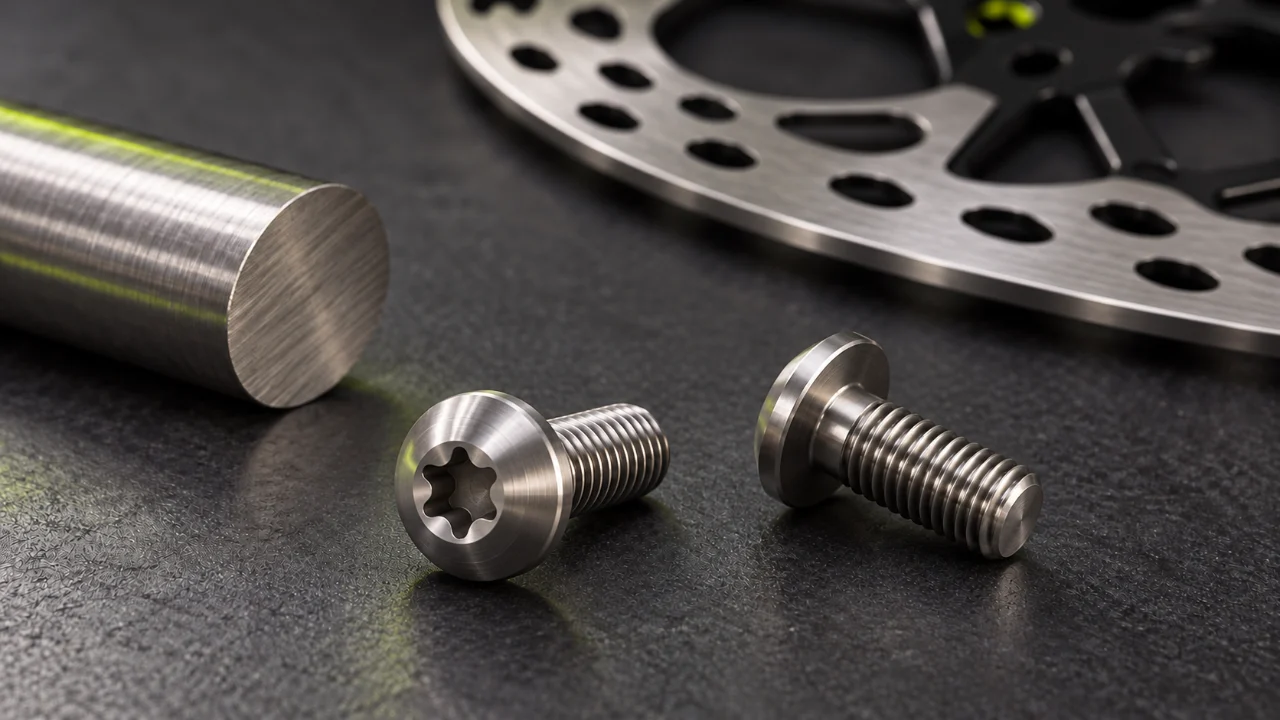
TC4 titanium is used in lightweight fasteners for more than its weight. It offers a useful combination of low density, strength and corrosion resistance. The alloy designation alone, however, does not establish whether a bolt is suitable for a particular connection.
For bicycle hardware, start with the requirements of the joint, then choose the material.
Are TC4, Ti-6Al-4V and Grade 5 the same material?
These names generally refer to the same widely used alloy family. TC4 is the Chinese designation. Ti-6Al-4V describes a nominal composition containing about 6% aluminium and 4% vanadium. Grade 5 is a common designation in international purchasing.
The names identify a material category; they are not a universal certificate of suitability. Check the applicable specification, supply condition and batch documentation. Compliance with a raw-material specification does not, by itself, verify a finished bolt for a particular bicycle component.
How much weight can titanium bolts actually save?
Ti-6Al-4V has a density of approximately 4.43 g/cm³, lower than that of common steels. With identical geometry, a titanium bolt will generally weigh less. TIMET's material datasheet reports a similar density.
The density difference is not a measured weight-saving percentage for a finished product. Head shape, length, drive recess and other design details also affect mass. Compare the measured weights of equivalent finished bolts rather than treating a density calculation as a product measurement.
Why is tensile strength only part of the picture?
Material-property values refer to particular specimens, supply conditions and test methods. A finished bolt also has thread roots, a head-to-shank transition and a drive recess. Dimensional accuracy and surface condition matter as well.
A material's tensile strength should therefore not be translated directly into a claim that a bolt can safely carry a particular number of kilograms. Bicycle joints also involve preload, repeated loading, mating components and installation conditions. Material data supports selection; it does not replace verification of the fastener and joint.
For that reason, this article gives neither a universal load rating nor a single torque value for titanium bolts.
What should you check besides the M5 designation?
M5 specifies the nominal thread diameter, not the complete bolt. For an M5×10 mm bolt with a T25 drive, check the following:
| Item | What to confirm |
|---|---|
| Thread pitch | Match the hub's specified pitch, not just its thread diameter. |
| Under-head length | Measure from the head's bearing surface to the tip and compare with the original specification. |
| Head and bearing surface | Confirm head diameter, height and bearing-surface geometry suit the rotor mounting arrangement. |
| Engagement and clearance | Meet the required thread engagement without bottoming out or interfering with nearby parts. |
| Drive and retention | Follow the specified tool, washer, locking plate or thread-retention requirements. |
Similar appearance does not establish interchangeability. For brake-related connections, confirm the requirements of the rotor, hub and replacement fastener before fitting.
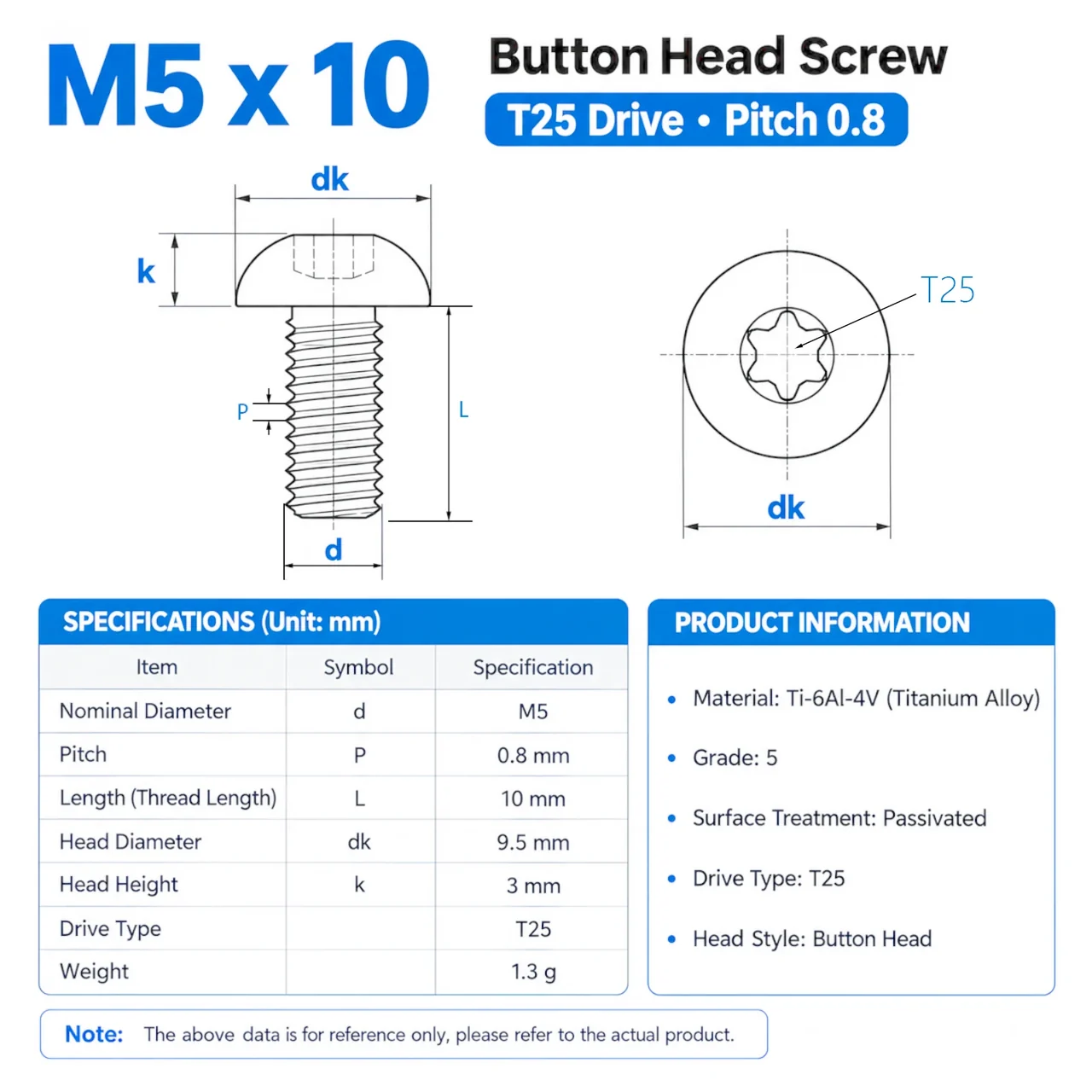
An M5×10 T25 dimensional example. Specifications apply to the product shown.
Why does friction matter during installation?
Titanium threads can be susceptible to galling. If a bolt develops unusual resistance, stop rather than forcing it. Check alignment, cleanliness and dimensional compatibility first.
Lubricants and threadlocking compounds are not interchangeable choices. They change friction and can change the preload produced at a given tightening torque. Whether to use a compound, which product to use and what torque to apply should follow the relevant component and fastener instructions.
Do not automatically apply a dry-thread torque specification to a lubricated joint. If the instructions conflict or leave the assembly condition unclear, ask the component supplier before proceeding.
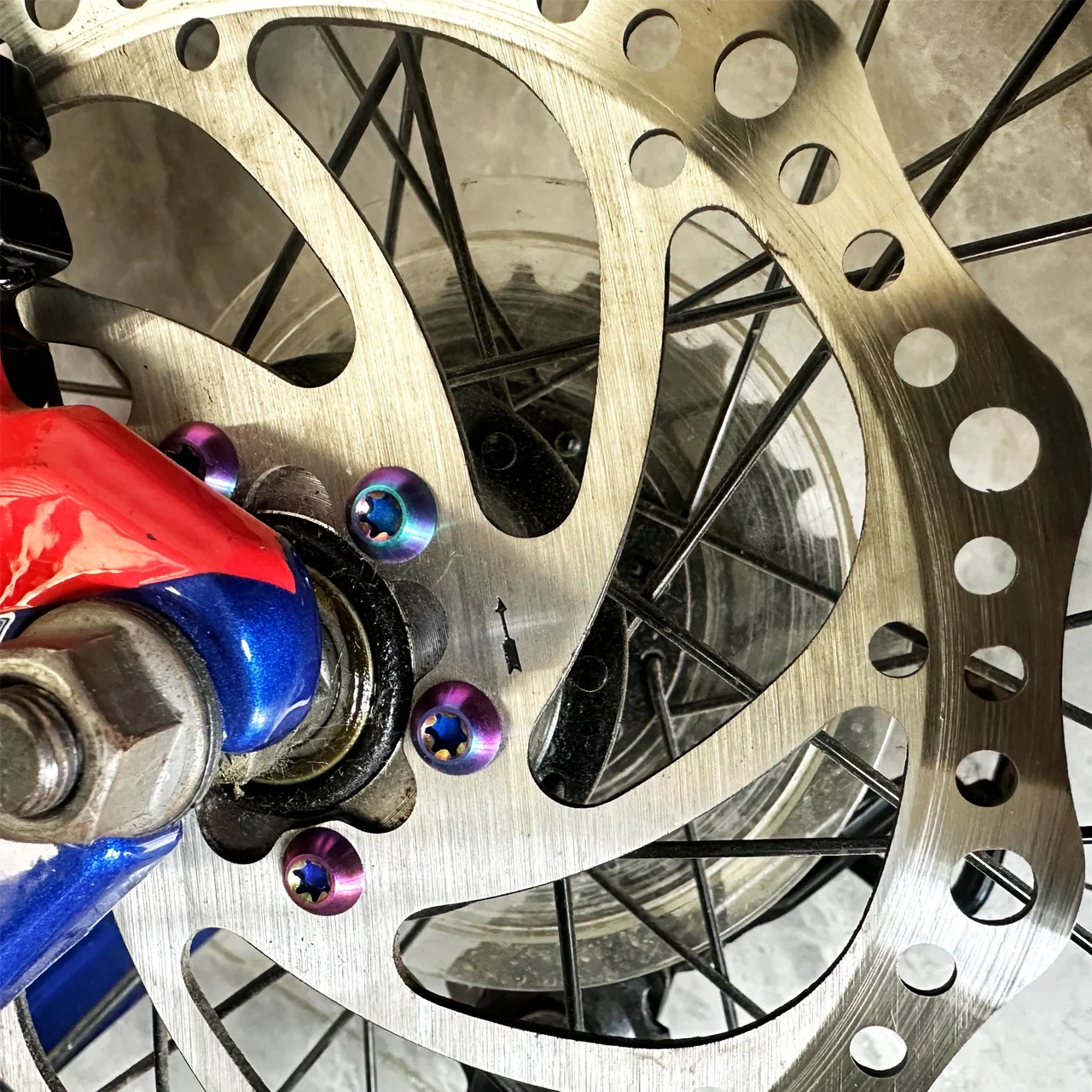
Rotor bolt installation photograph, not a torque or compatibility test.
Does corrosion resistance remove the need for maintenance?
No. An alloy's corrosion resistance and a joint's durability are different questions. Mating materials, moisture, contamination and surface treatments all belong in the assessment.
Use cleaning and maintenance methods permitted by the component manufacturer. Titanium hardware still needs checks for loosening, unusual wear and changes in the condition of the joint.
What is worth asking a supplier?
- The alloy designation, applicable material specification and available documentation.
- Exact thread, length, head and bearing-surface dimensions.
- Fitment requirements for the intended mounting position rather than a general claim of universal compatibility.
- Installation requirements, including torque, retention and thread-treatment conditions.
- The finished product and test conditions behind any weight or performance claim.
TC4 provides an option for reducing weight. A sound choice of bicycle hardware considers the material, dimensions, manufacture and installation together.
For a specific dimensional example, see the dubee M5×10 T25 titanium disc brake rotor bolts. Those dimensions describe that product, not every TC4 fastener.
About the sources
Prepared by dubee with reference to the supplied compilation, TC4 Titanium Alloy: Material Properties and Industrial Applications (22 October 2026), and TIMET's TIMETAL 6-4 datasheet. Material reference values are not a test report, certification or installation guarantee for dubee finished products. The cover is an illustrative material-themed image; the dimension drawing and installation photograph come from the product materials.
References
- TIMETAL 6-4 (Ti-6Al-4V / ASTM Grade 5) — Material Datasheet · TIMET — Titanium Metals Corporation