Materials
How to Tell If a Titanium Bolt Is Real: 5 Checks (and What They Can't Prove)
Five practical checks for titanium bolts, their limitations, and how traceable documents or laboratory testing can support grade identification.
Published: · Updated:
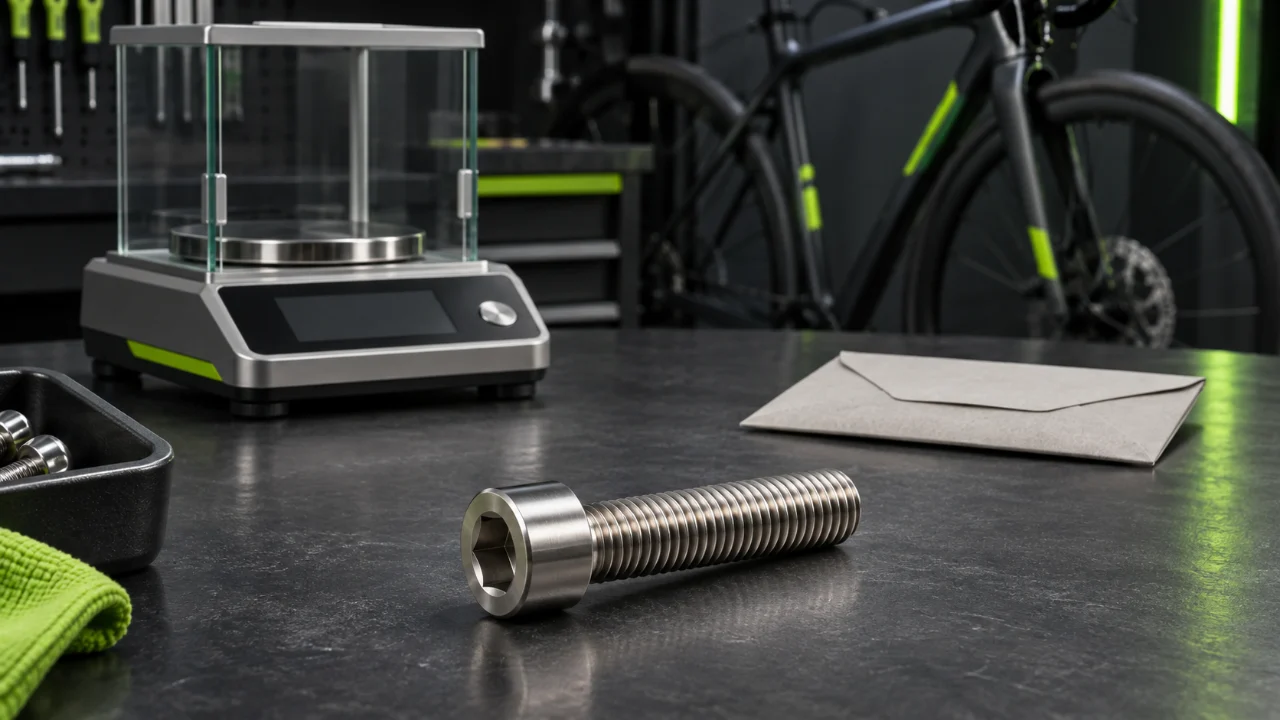
Home checks can flag a bolt that is unlikely to be titanium, but they cannot establish that it is Ti-6Al-4V or Grade 5. For a confident grade identification, ask for a traceable material certificate or a laboratory report for a representative sample. Even then, confirm that the document actually applies to the part you received.
Why “looks like titanium” is not enough
A finish can make different metals look alike. A stamped grade is a useful starting point, but a marking alone is not proof of composition. The question is not simply whether a bolt looks convincing: it is whether the claimed material can be traced to credible evidence.
Five checks you can do
| Check | What it can tell you | What it cannot prove |
|---|---|---|
| Markings and documents | What is claimed and whether paperwork can be traced | A marking alone cannot prove grade |
| Magnet | Strong attraction raises questions about the claimed material | Weak attraction does not prove titanium |
| Density and weight | Whether an approximate result is consistent with titanium | An alloy grade or finished-bolt strength |
| Colour and finish | Whether the finish matches its description | The metal beneath a coating |
| Price and seller | Whether to ask further questions | Whether a particular bolt is genuine |
Check 1: Markings and documents
A bolt marked “Ti” or “Grade 5” carries a claim, not a laboratory result. Marks can be copied, and small bolts may have no marking at all. Ask the seller for the exact grade and the relevant specification, then request a certificate that identifies the material, heat or batch number, test results and supplier.
An EN 10204 3.1 inspection certificate is one possible form of documentation. ASTM B348 and AMS 4928 are examples of specifications associated with titanium bar or related product forms; their relevance depends on what was purchased and the applicable edition. A bar certificate does not automatically prove that a finished bolt came from that bar. Ask how the supplier maintains traceability from the heat through processing to the delivered lot.
Check 2: Magnet
Titanium is not strongly attracted to a household magnet. But a bolt that does not stick is not necessarily titanium: annealed 304 and 316 stainless steels can also show little attraction. Some stainless steel can become noticeably magnetic after cold working. A strong response is a reason to investigate, not a complete material identification; washers, plating and other attached parts can also affect the result.
Check 3: Density and weight
Titanium alloys typically have density around 4.4–4.5 g/cm³; many steels are around 7.8–8.0 g/cm³. These are approximate reference values, not acceptance limits for a particular bolt. Aluminium and other materials can also be light, so weight alone is not proof.
If a sample is large enough for your equipment, estimate density as mass in grams divided by displaced water volume in cubic centimetres. Weigh the dry sample, then measure the water-level difference with and without the fully submerged sample. Do not include a different-material washer. Threads can trap air, coatings add material, and the very small volume of a single bolt can make ordinary kitchen-scale and measuring-cylinder errors dominate the result. Repeated measurements or multiple identical bolts may improve a rough estimate, but cannot identify Grade 5.
Check 4: Colour and finish
Colour is not evidence of the base metal. Titanium can be anodized to produce colours, while a PVD coating can give steel a blue or rainbow appearance. Lighting, surface preparation and coatings also change the apparent shade. Ask what finish is specified, and do not treat an attractive colour as a material test.
Check 5: Price and seller
An unusually low price, a listing that says only “titanium alloy”, or a seller unwilling to discuss traceability are reasons to ask questions. They do not by themselves establish that a product is counterfeit. Request the grade, specification, documentation and return policy before drawing a conclusion.
What actually confirms the grade
A traceable, credible material certificate can support the claimed grade when its heat and processing records can be linked to the supplied part. A laboratory can test a representative sample against the relevant composition requirements. Handheld XRF is useful for screening certain alloying elements, but its limitations—including light elements and surface coatings—mean it may not establish full compliance on its own. ICP-OES or ICP-MS may be used for suitable composition analyses; the laboratory must choose methods for all elements required by the specification. Hardness, tensile testing and metallography can add information about condition or properties, but do not independently establish chemical grade. Testing one sample does not automatically certify every bolt in a lot.
What not to do
Do not use acids, grinding-wheel spark tests or file tests at home. These methods can damage the fastener and do not reliably establish its grade. Titanium dust can present a fire hazard. Keep questionable fasteners out of safety-critical assemblies until their suitability is resolved.
Before you buy: questions to ask
- What grade and product specification apply?
- Is there a heat or batch number, and how is it linked to these finished bolts?
- Can you provide an EN 10204 3.1 certificate where applicable?
- Can a representative sample be independently tested?
- What are the return options if documentation cannot be verified?
For material background, read why TC4 is used for bicycle bolts. For dimensions and installation, see the bike bolt fitment guide. Explore M5×10 T25 disc rotor bolts or M5 stem bolts with washers, and ask for a quote. Product material claims are supplier-stated; request batch-specific documentation. Follow the component manufacturer's installation instructions.
FAQ
If a magnet does not stick, is the bolt titanium?
No. Some 304 and 316 stainless steel is also weakly magnetic or effectively nonmagnetic in a household check.
Does colour identify titanium?
No. Coatings can create similar colours on different base metals.
Is a light bolt necessarily titanium?
No. Weight depends on geometry and material; other metals can also be light.
What if there is no certificate?
Ask for traceable documentation or independent sample testing. Without suitable evidence, leave the grade unconfirmed.
What should I do if I suspect a bolt is not genuine?
Keep the packaging and order details, contact the seller, and avoid installing it in a safety-critical connection until the issue is resolved.
Conclusion
Use home checks to identify inconsistencies, not to certify a grade. A traceable material certificate or appropriate laboratory analysis provides stronger evidence; the link between that evidence and the delivered bolt matters as much as the document itself.
References
Related Articles
View all articles →
Materials
Why Choose TC4 Titanium Bicycle Bolts? What Matters Beyond Weight?
What do TC4, Ti-6Al-4V and Grade 5 mean? A practical guide to material properties, rotor bolt dimensions and installation requirements when choosing titanium bicycle hardware.
Updated: