Sizing & Fitment
How to Choose Titanium Bolts for Your Bike: Size, Fitment & Torque Guide
Learn how to check bicycle bolt sizes, thread pitch, length, head fit and OEM torque requirements before choosing titanium rotor, stem or bottle cage bolts.
Published: · Updated:
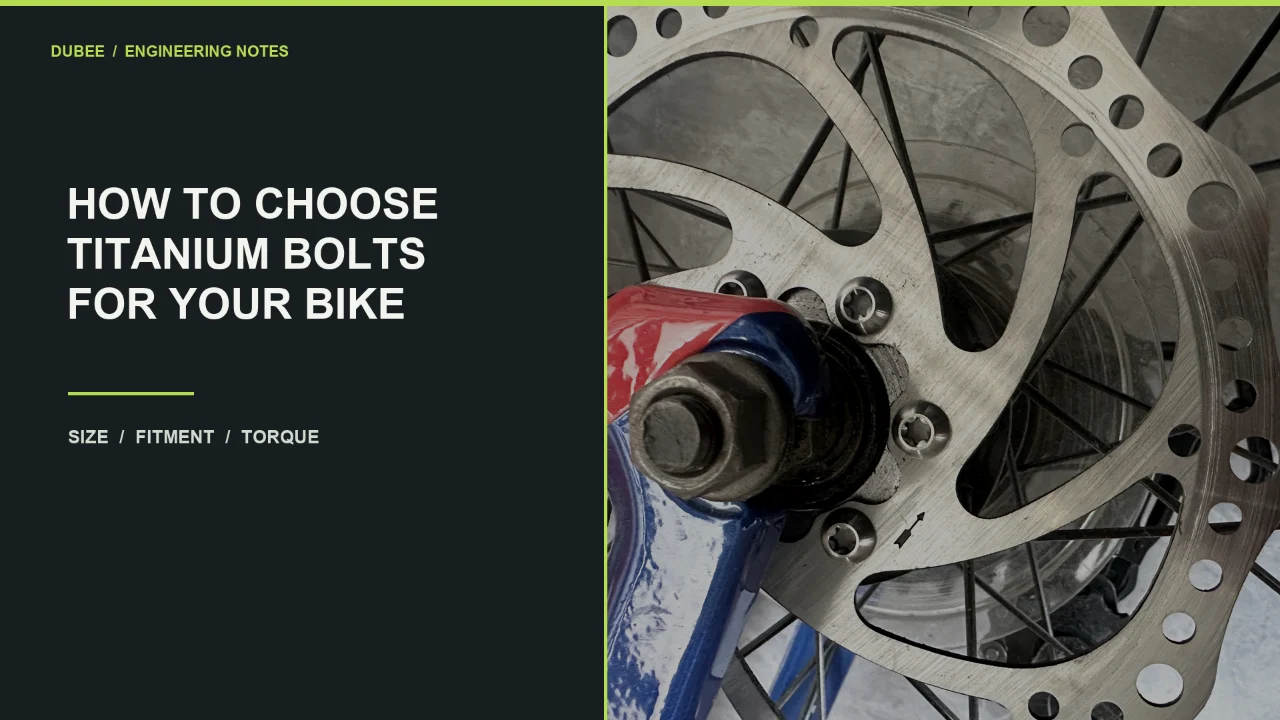
Before choosing a titanium bike bolt, identify where it will be used. Even if the diameter matches, differences in pitch, length, head shape or installation conditions can make a replacement unsuitable.
Whether you are replacing a bolt yourself, servicing a bike or ordering parts, check the component’s fastener requirements and measurements first. Then confirm the replacement and installation procedure. This guide walks through those checks; always follow the instructions for your specific brake, hub, stem or frame.
1. Understanding Bicycle Bolt Sizes
Diameter and pitch describe different things
In a metric thread designation, M5 identifies a nominal thread diameter of 5 mm; M6 identifies 6 mm. These are nominal sizes, not a promise that every measured outside diameter will equal that number exactly.
Pitch is the distance between adjacent thread crests, measured along the bolt. It is separate from both diameter and length. A designation such as M5×0.8×10 states diameter, pitch and length; a product title shortened to M5×10 may omit the pitch. Check the specification instead of treating an incomplete title as the whole drawing.
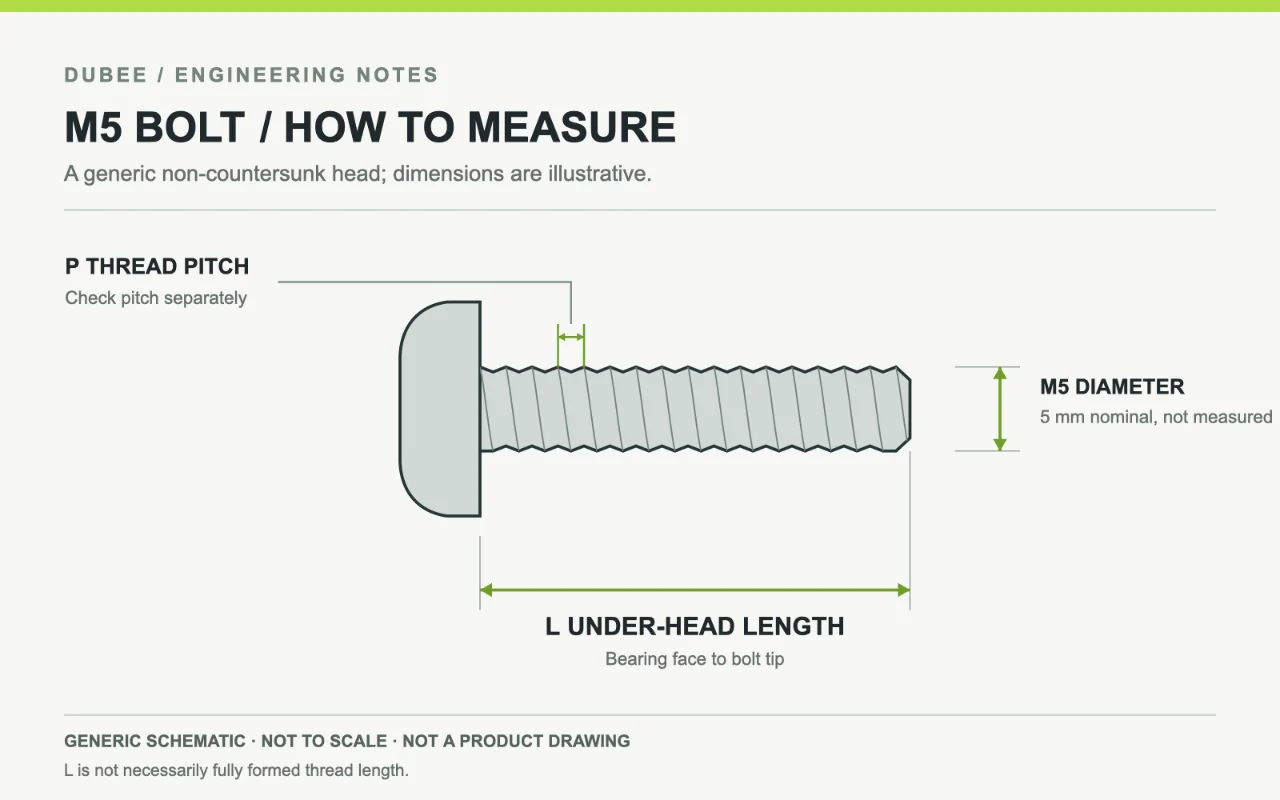
Why two M5 bolts may not interchange
Matching diameter does not establish matching pitch, head clearance, bearing surface, thread tolerance or approved material. Nor does it prove that the replacement has enough usable thread for the joint.
Before ordering M5 titanium bolts, identify where the original bolt came from. Keep bolts from different positions separate, and record any washer or locking hardware. The original part is a useful comparison only if it is the correct hardware for that component.
2. How to Measure Bicycle Bolts Correctly
Start at the correct length datum
For conventional button-head and socket-head cap screws, length is generally measured from the underside of the head to the tip. Flat countersunk screws are normally measured including the head. A decorative taper does not automatically make a bolt countersunk: use the drawing to identify its seating surface and length datum.
Use calipers for dimensions and an appropriate thread-pitch gauge for pitch. A ruler can help sort lengths, but cannot verify a thread tolerance or resolve a close fit. Pro-Bolt’s measuring guide illustrates the measurement process.
Separate bolt length from usable engagement
Under-head length is not necessarily fully formed thread length. A tip chamfer, thread runout or unthreaded section can reduce the length available to engage the mating thread.
The joint also takes up length: the bracket, faceplate, rotor and specified washers occupy part of the bolt. A longer bolt may bottom in a blind hole before it clamps the parts; a shorter one may provide insufficient engagement. Do not use one universal “times the diameter” rule to approve every titanium-to-aluminum connection.
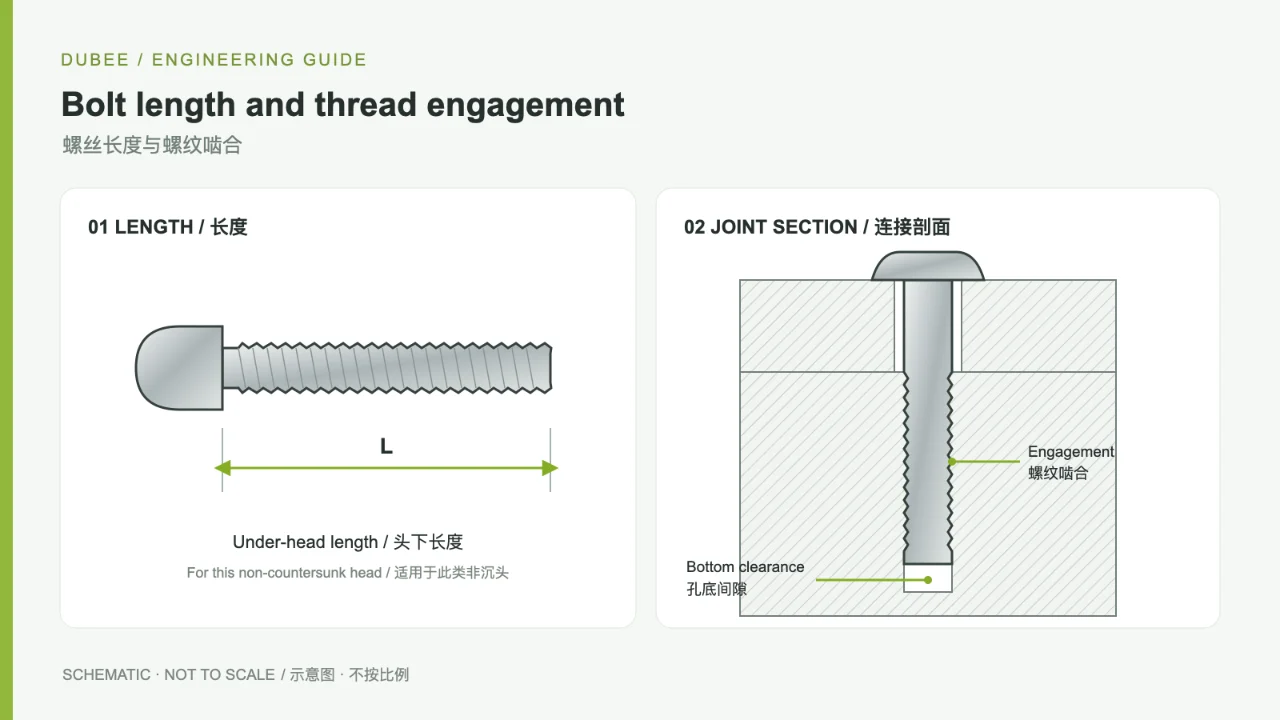
Check the head and surrounding space
Measure head diameter and height, and compare the underside bearing geometry. Check clearance to adjacent parts and access for the driver. Matching the thread while changing the seating surface can leave the assembly incorrectly supported.
A smooth hand start is a useful check, but does not certify the thread or the joint. If the bolt binds, stop rather than pulling it into place with a wrench. For purchasing inspection, request the drawing tolerances and applicable gauge results; calipers alone cannot establish thread conformity.
3. Common Bolt Head and Drive Types
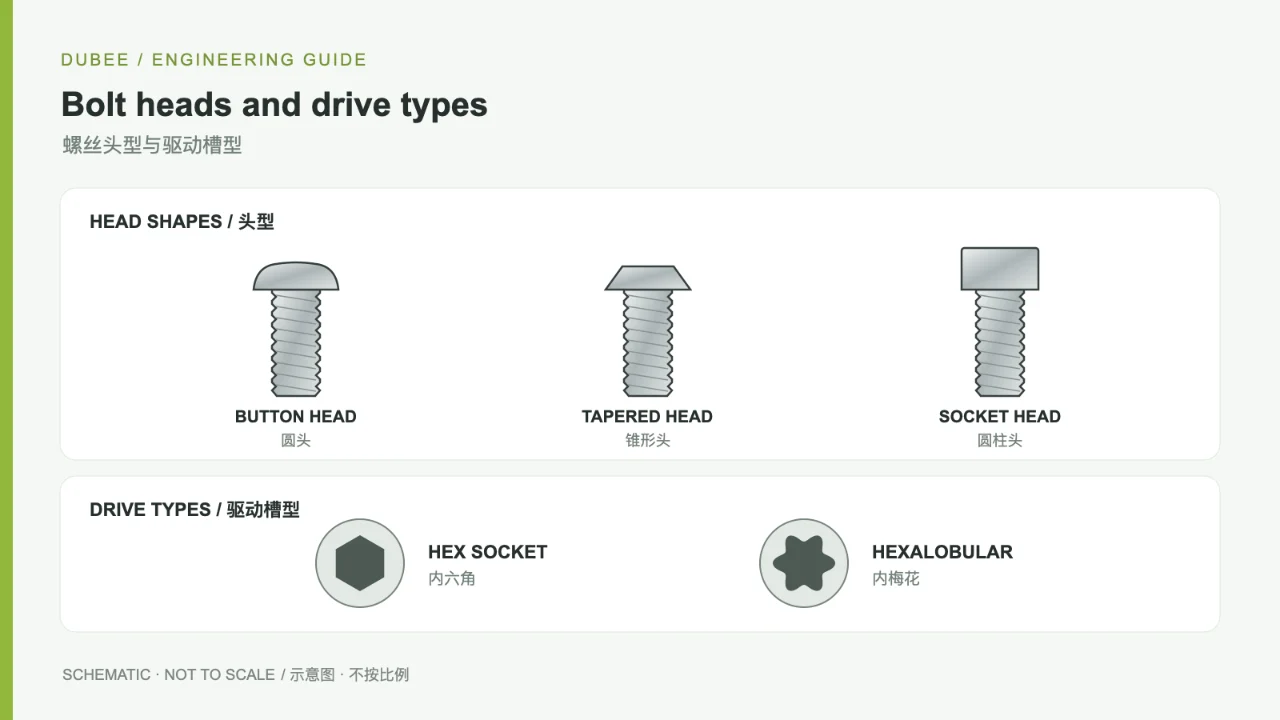
Head shape and drive type are separate choices. A low head does not identify the tool, and the same drive can appear in different head shapes.
| Feature | What to check |
|---|---|
| Button head | Rounded top; confirm head diameter, height and bearing surface. |
| Tapered head | A description that needs a drawing; check the actual seat rather than assuming a countersunk fit. |
| Socket-head cap screw | Typically a cylindrical head; check available height and any recess around the head. |
| Hex socket | An internal hexagonal drive; use the specified metric key or bit. |
| Torx or hexalobular drive | An internal six-lobe drive; match the specified T-size. T25 is a tool designation, not a 25 mm hex key. |
Select a sound bit that seats fully, with room to keep it aligned. A worn or partially engaged tool is a reason to correct the setup, not apply more force. Bossard’s assembly-tool information distinguishes drive shapes and assigned tool sizes.
4. Choosing Bolts for Different Bicycle Components
Six-bolt disc brake rotors
Check the hub and rotor models together, including the required fasteners and locking arrangement. Six-bolt mounting and Center Lock are different interfaces; a purpose-designed adapter has its own hardware requirements. Rotor bolts also differ from caliper and brake-adapter fixing bolts.
The reference drawing for dubee’s M5×10 T25 Titanium Disc Rotor Bolts labels an M5 thread, 0.8 mm pitch, T25 drive and button head. Its 10 mm arrow runs from the underside of the head to the end. The image is explicitly for reference, not a controlled production drawing or batch inspection report. It does not establish full thread engagement, pack quantity or compatibility with every six-bolt hub.
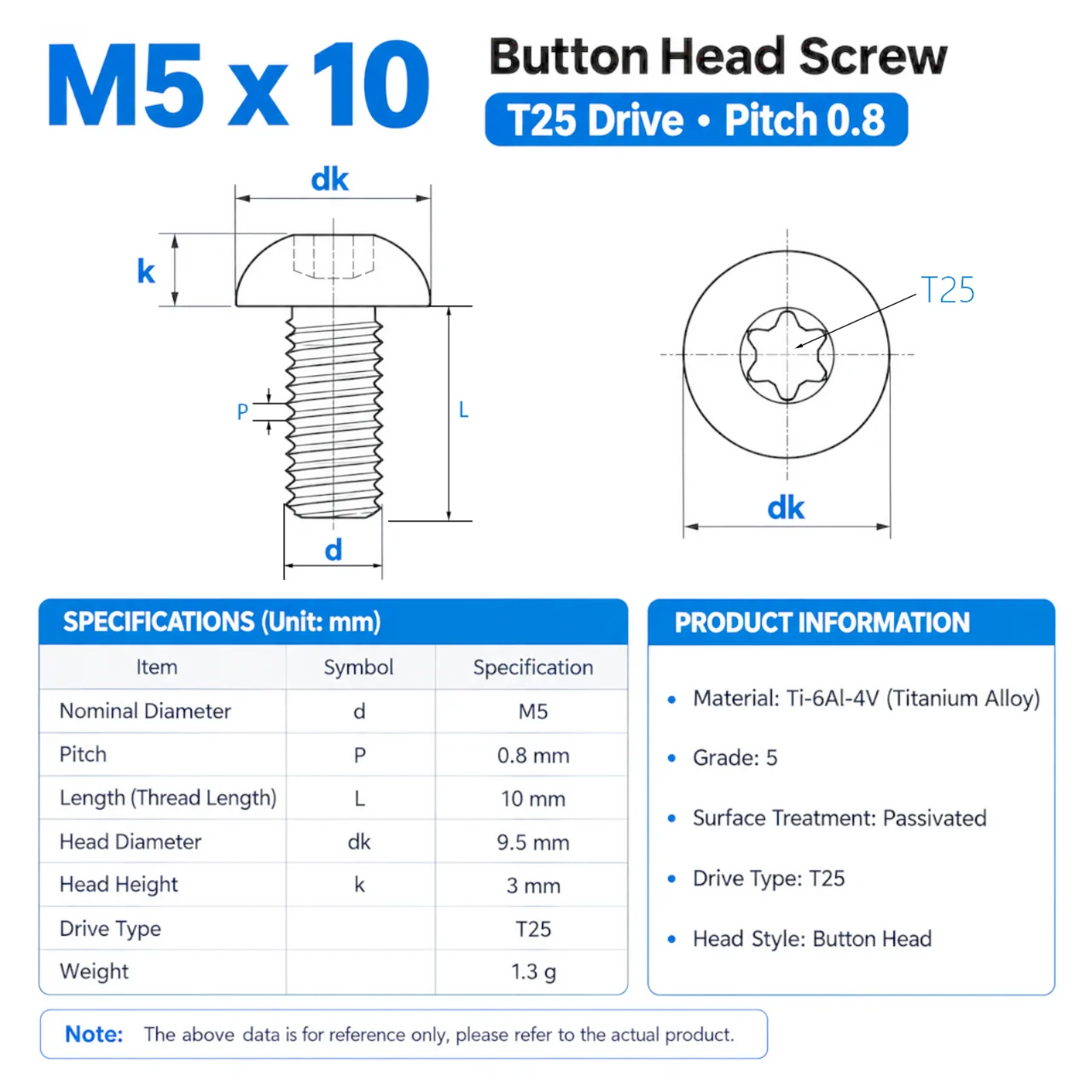
Measure each of these features before buying; the product name alone cannot confirm whether a replacement will fit.
Stem bolts
Distinguish the handlebar faceplate, steerer clamp and headset top-cap preload bolt. They serve different functions. Follow the particular stem’s tightening sequence and faceplate-gap instructions; some designs differ from the familiar even-gap arrangement.
When enquiring about dubee’s M5 Titanium Stem Bolts with Washers, specify whether you require M5×16, M5×18 or M5×20. The product page lists all three lengths, but that does not mean they fit every stem. Before ordering, check the mounting position and confirm the length measurement datum, drive size, head seat and washer dimensions.
Do not add or remove washers merely to make a different length appear to fit. The washer and head form part of the intended bearing arrangement.
Bottle cage bolts
A bottle-cage mount still needs the right thread, length and head. Check the frame or mounting-system instructions, insert depth and cage thickness. Stacking an accessory under the cage changes the assembly and needs a fresh length and clearance check. Do not assume a bolt is suitable because it was used on another bike.
5. Titanium Bolt Installation and Torque
There is no universal titanium bolt torque
A material name and an M-size are not enough to select a tightening torque. Torque is an indirect way of controlling preload, and friction affects the result. Thread and under-head conditions, geometry and the mating assembly all matter. The NASA Fastener Design Manual discusses these variables; it is engineering background, not a bicycle installation approval.
Obtain the original equipment manufacturer’s instructions for the exact component. Confirm that they cover the proposed replacement hardware and preparation method. A torque printed for the original steel bolt does not, by itself, authorize a titanium substitution. If instructions conflict, ask the relevant manufacturer to resolve the combination; do not invent a compromise value.
Threadlocker, lubrication and anti-seize
These products are not interchangeable instructions. Use only the thread preparation specified for the approved assembly. Titanium can gall, but that does not justify applying anti-seize to every titanium bolt or using a dry-assembly torque after changing the friction conditions.
Keep oil and grease away from rotors and brake pads. Park Tool’s rotor guide specifically cautions against greasing or oiling rotor bolts because contamination can migrate to the braking surface. Do not apply a general lubrication tip to a brake joint.
Where threadlocker is specified, follow the relevant product instructions for preparation and curing. Henkel’s LOCTITE 243 technical data sheet shows that curing depends on conditions including substrate, gap and temperature. Its laboratory breakaway torque is not an installation setting for an M5 titanium bolt.
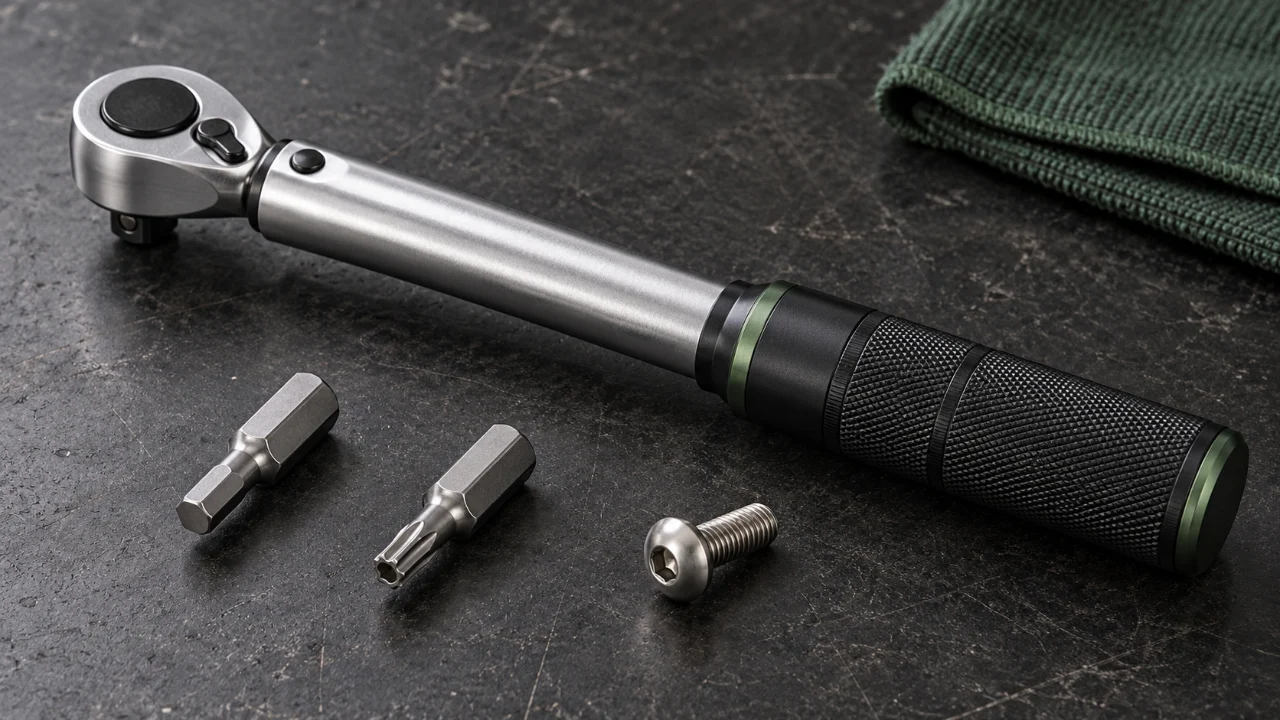
Tool preparation illustration; it does not represent a measured torque result or installation approval.
Checks before and after assembly
Before starting, confirm the component model, approved fastener, thread condition, washers, preparation and torque procedure. Use a suitable torque wrench and matching bit, and follow the specified sequence.
After assembly, check seating, required gaps, clearance and component function. Inspect or recheck at the intervals the manufacturer specifies. If a part slips, binds or does not seat correctly, stop using the bike until the cause is resolved; increasing torque is not a substitute for correcting the fit.
6. When Not to Replace Original Bolts
Keep the specified hardware when the replacement lacks evidence for a safety-critical connection. Braking and steering deserve particular attention, as do proprietary fasteners with unusual shoulders, captive washers, locking features or seats.
TC4 or Ti-6Al-4V is not a universal equivalent to every steel fastener grade. Material properties do not establish finished-bolt fatigue performance, drive strength or joint suitability. For the material background, read why TC4 titanium bicycle bolts need evaluation beyond low weight.
If the supplier cannot identify the proposed part or explain its fitment, retain the manufacturer’s specified hardware while seeking clarification. Avoid choosing by appearance, brand name or an unqualified “fits most bikes” claim.
7. Bicycle Titanium Bolt Buying Checklist
Use this checklist for each mounting position.
| Check | Record before buying |
|---|---|
| Component identity | Manufacturer, model and mounting position |
| Replacement permission | Original part number or manufacturer confirmation |
| Thread | Diameter, pitch and specified tolerance |
| Length | Measurement datum and usable threaded portion |
| Joint fit | Required engagement, available hole depth and clearance |
| Head and drive | Seat, diameter, height, drive and tool access |
| Washers and locking parts | Specified shape, dimensions and arrangement |
| Material and quality | Grade, condition, traceability and applicable inspection evidence |
| Installation | Approved torque, preparation, sequence and recheck instructions |
| Order contents | Exact variant, quantity and included hardware |
For workshop or purchasing records, keep the drawing revision and supplier confirmation with the order. Product photos are useful for identification, but do not replace dimensions or inspection records.
8. Frequently Asked Questions
Are all M5 bicycle bolts the same?
No. M5 identifies nominal diameter. Pitch, length, tolerance, head, drive, material and the connection’s requirements still need checking.
Is M5×10 the same as 10 mm of thread engagement?
No. The length datum must be confirmed, and part thickness, washers and incomplete threads affect usable engagement. The dubee reference drawing shows a 10 mm under-head dimension, not a verified installed engagement.
What torque should I use for M5 titanium bolts?
Use the procedure approved for your exact component and replacement hardware, including thread preparation. There is no universal M5 titanium installation torque.
Should I use anti-seize on titanium rotor bolts?
Do not apply it merely because the bolts are titanium. Follow the approved brake assembly instructions and keep braking surfaces free of contamination. Clarify any conflict before installation.
Can titanium stem bolts replace the original steel bolts?
Only when the proposed hardware is suitable for the specific stem and the manufacturer’s requirements are satisfied. Matching diameter and length alone does not establish safe interchangeability.
Does a T25 drive mean a 25 mm bolt or a 25 mm hex key?
Neither. T25 identifies the drive size. Thread diameter and bolt length are separate specifications; use the matching T25 bit.
9. Conclusion
Start with the mounting position, then check the diameter, pitch, length, head bearing surface and installation requirements. Only after those details match can you assess whether a titanium replacement is suitable.
Use dubee’s product pages to identify the hardware you want to discuss, and request the missing specifications before ordering for a particular component. If the fitment or installation evidence is incomplete, keep the manufacturer’s specified fasteners until the questions are resolved.
Related Articles
View all articles →
Sizing & Fitment
Are All 6-Bolt Disc Rotor Bolts Interchangeable? Size, T25 & Torque Explained
Learn how to check M5×10 and T25 rotor bolts for fit, thread engagement and clearance—and where to find the correct installation torque.
Updated: